Showing posts with label children book. Show all posts

Friday

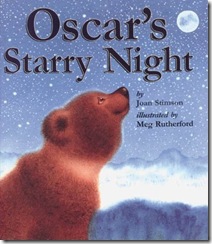
Oscar's Starry Night. Editorial Reviews

Oscar's Starry Night. Review

Oscar is a bear who spends the night outdoors with his friend. He has mixed feelings as night falls. Oscar is depicted as an extremely soft bear with luminous eyes. Gently humorous. A 1999 Parents' Choice® Silver Honor Winner. (Kemie Nix, Parents' Choice®).

Oscar's Starry Night. Product Description

Oscar's Starry Night. JOAN STIMSON. Illustrated by MEG RUTHERFORD. Book Story, text, find, buy online amazon, download for free. Illustrations, images, pictures. review, description. Most children get enthusiastic at the thought of camping out in the backyard, but when they actually pitch the tent behind their house, fear of the darkness comes over them. Such is the tale of Oscar, the bear cub, and Ollie, his friend.

In Oscars Starry Night, by Joan Stimson with illustrations by Meg Rutherford, youngsters are reunited with their favorite bear cub for an outdoor sleep-over that gets a little scary when the sky turns black.

Every page of this hardcover book is filled with beautiful illustrations that tell the delightful story of Oscar and Ollies sleep-over. Together the two cubs overcome their fear of the dark and spend the night counting the stars in the sky.

Children ages three to six will relate to Oscars fear of the dark and thoroughly enjoy the charming tale of two friends who help each other. Oscars Starry Night follows the popular hardcover book, Oscar Needs a Friend, also an adorable story about the adventures of Oscar and Ollie.

Read the original text of the story >>>

Thursday

How to Conquer and Overcome Children’s Fear of the Dark? Oscar's Starry Night Review

All children must conquer their fear of the dark

How to Conquer and Overcome Children’s Fear of the Dark? Oscar's Starry Night Review The first camp out is a major event in the lives of children. When I was young, my brother and I would stay at my grandmother's and I had two uncles who were my age. We would use old blankets to make tents over the clothesline and the four of us often vowed that we would sleep out there that night. However, we never had the courage to do so until one night the neighbor boy wanted to stay with us. This gave all of us the courage to sleep out in the tent.

To young people, the night can be frightening; there are noises and sensations that seem to arise everywhere. This book is about two young bears sleeping outside for the first time. Oscar has been invited over to his friend Ollie's place and they are sleeping out under the stars. At first, Oscar is a bit scared, but once Ollie admits that he too would be frightened if Oscar wasn't there, Oscar gets over his fear. This allows both of them to enjoy the moonlit night.

Getting over fear of the dark and the unknown is something that all children must do. It takes time and the right circumstances and in most cases it takes a companion, a friend, sibling or other relative of the same age. The lesson here for children is that fear of the dark is natural and in some ways healthy. Learning to conquer it is also natural as overcoming that fear is often the first step towards conquering all others and a successful life.

Charles Ashbacher

Good anti-fear book: Oscar's Starry Night. Buy online now >>>Oscar's Starry Night

Joan Stimson’s Book. Product Details

Oscars-Starry-Night-1
  • Reading level: Ages 4-8
  • Hardcover: 32 pages
  • Publisher: Barron's Educational Series; First Edition edition (September 1999)
  • Language: English
  • ISBN-10: 0764152076
  • ISBN-13: 978-0764152078
  • Product Dimensions: 10 x 8.5 x 0.3 inches
  • Shipping Weight: 9.6 ounces

    Oscar's Starry Night. Buy online now >>>Oscar's Starry Night

  • Tuesday

    How to overcome a fear of the dark

    Overcoming the fear of the dark takes patience, but with a little effort most individuals are able to conquer their fear quickly.

    How to Conquer and Overcome Children’s Fear of the Dark? Fear of the dark, like most other phobias, is an irrational fear that affects a person’s ability to react to situations or circumstances. Many children develop or express a fear of the dark at some point in their development, usually triggered by a specific situation such as; watching a scary movie, hearing ghost stories, or being introduced to fictional characters such as the “bogey man” or “monsters in the closet.”

    Overcoming and handling a fear such as this takes empathy, and some patience, but with a little effort most individuals are able to conquer their fear of the dark quickly and effectively.

    As a parent, it is important that you take a child’s expression of fear, be it of the dark, spiders, or what have you, seriously. Fear is an emotion. Until they are given the tools to control and overcome their fears, they will react to the stimuli in an emotional way. Nervousness, crying, insomnia, and in extreme cases, panic attacks are nature’s way of telling you that this is a serious situation and should be dealt with in a caring and supportive manner.

    Talk to your child about his or her fear. Ask questions like: “What is it about the dark that frightens you?” “What do you think might happen in the dark?” Determine if an outside factor, like a sibling, movie, or story heard has initiated this fear. Most importantly let the child know that you will safeguard them, and help them get through this fear response.

    Desensitizing your child may be the next step. Offer the use of a night-light, but slowly introduce them to a darker and darker environment in a safe and non-threatening way. Make sure the steps are small, and at the child’s own pace. Perhaps leave a hall light on, with the door to their room open, and night after night, close the door a fraction of an inch more. Create a reward system for your child, each night that they progress in the darker and darker environment may get them closer to getting their favorite ice cream for dessert!

    Don’t belittle your child, or force the issue. You want to build their confidence to conquer not only this fear, but also any other stressful situations they may face in the future! Congratulate them on their ability to keep trying, and boost their self-esteem in other ways all throughout the day. By the time they go to face the dark, they will see it through the eyes of a more confident child, and be able to step closer to overcoming the fear entirely.

    Should this fear build, and the child’s response to it, in spite of slow desensitizing, become more and more extreme, see your doctor. Monitor their diet to see if late night sugars or other physical or psychological factors are working against his or her ability to overcome this fear. Get the whole family involved, and make sure siblings are being supportive, and that no one is putting a negative spin on your child’s expression of his/her fears. There should be no name-calling or insinuations that any phobia is a sign of weakness or immaturity.

    Also, make sure that your child is receiving positive attention from you in other situations throughout the day. If your child feels that the only quality time they spend with you is in relation to this fear, they may continue the phobia as a means of gaining your attention and support.

    Adults with the same phobia also react to the dark negatively most often due to a traumatic experience or association with darkness. As an adult, dealing with the cause of the fear is the key to overcoming it. Counseling sessions with a therapist may help adults interpret their fears and recognize the contributing factors. Once the fear is dissected, and the originating cause is determined, they too can begin to desensitize themselves, and provide themselves with reasonable safety measures that will keep the fear from overwhelming and interfering with normal life.

    Read more about how to overcome a fear of the dark >>>

    Good anti-fear book: Oscar's Starry Night. Buy online now >>>Oscar's Starry Night

    Source

    Sunday

    Fear of Darkness. How to Conquer and Overcome Children’s Fear of the Dark?

    Lots of kids are afraid of the dark. Whether it’s the boogeyman in the closet or a monster under the bed that’s haunting them, here’s how parents can help their kids conquer their fears.

    Fear of Darkness. How to Conquer and Overcome Children’s Fear of the Dark? Jennifer Bianco of Lincoln, R.I., has two kids who are afraid of the dark. Her 6-year-old daughter absolutely must sleep with a blanket to help combat her fear, and her 4-year-old son insists on sleeping with a night-light.

    Bianco isn’t sure when or why her children developed a fear of the dark, but she’s absolutely positive her kids' anxiety level goes up when the lights go down.

    “What exactly they are afraid of when it’s dark I’m not sure, but I do know their fear is very real,” she says.

    Millions of kids are convinced that something is lurking in the shadows waiting to gobble them up. Experts share with WebMD some theories on where the fear of the dark comes from, why it feels so real when you’re only 3 years old, and what parents can do to help their kids tackle their anxiety.

    First Fears

    “Some people expect that kids should never really have fear, and of course they do,” says Mary Dobbins, MD, a pediatrician and child psychiatrist in Springfield, Ill.

    Fear is a normal part of life for all of us, including young children. It tends to start when you try something new, something that you’ve never experienced before, something that is an unknown.

    For kids, this happens almost every day, so fear has a lot of opportunity to rear its ugly head -- especially at night.

    “The fear of the dark tends to evolve around the time children are old enough to have a sense of imagination,” says Jenn Berman, PhD, a family therapist in Beverly Hills, Calif.

    Usually, the fear of the dark hits home for kids around the ages of 2 or 3, when they’re old enough to imagine, but not wise enough to distinguish fantasy from reality, Berman says.

    This gives the unknown an opportunity to turn scary. Add to that a blank slate of a young brain -- with no distractions to preoccupy the mind -- and a shadow in a dark corner of a child’s bedroom can easily become a three-headed beast.

    “There are fewer distractions to keep a child’s mind occupied at night,” says Dobbins, who is also an assistant professor of pediatrics and child psychiatry at Southern Illinois University. “So instead, his imagination runs wild, and as a result, a kid who seems well adjusted during the day may be more vulnerable at night.”

    Where Fear of the Dark Comes From

    So what causes kids’ fear of the dark?

    “Television is one of the worst offenders when we’re talking about a fear of the dark,” Berman says. “Parents don’t recognize how much TV can affect their children.”

    The sights and sounds on TV are too stimulating for their brains, she says, exposing kids to things that might not be scary for an adult but are terrifying for a child.

    Where Fear of the Dark Comes From continued...

    “Most parents don’t limit what their kids are watching on TV,” Dobbins tells WebMD. “For instance, a young child, in a room watching TV with an older sibling, might be watching something totally age-inappropriate.”

    Whether it’s a violent news story or even a popular cartoon program, both experts say that TV can give kids plenty of ammunition when it comes to fear.

    Books are also culpable in creating nighttime havoc for a kid, Berman says.

    The images can be intimidating and provoke already active imaginations, stirring up all sorts of ideas that can come back to haunt a child who is lying alone in the dark. From drawings of monsters to fairy tales and witches, kids can misinterpret images and conjure up fears that an adult might not recognize.

    And surprisingly, another culprit when it comes to nighttime fears is a well-intended parent who tells a child, “You better behave, or the boogeyman will get you,” Dobbins says. Although it might seem like light-hearted discipline, this simple phrase can instill a solid case of nighttime heebie-jeebies for a kid.

    “While most kids will have some degree of a fear of the dark as they’re growing up for whatever reason, the good news is, it can be solved,” Dobbins says.

    Fear of the Dark: Dos and Don’ts

    The best thing a parent can do for a child with a fear of the dark is to communicate, be respectful, and show that you understand.

    “If you’ve been communicating with them from the start, they can understand when you talk to them about their fear of the dark,” Berman says. “And be respectful -- don’t tell them their fear is silly, because not only does it not help and they’re still scared, but now they feel guilty and ashamed, too.”

    From calm, cool, and collected to recognizing something more is at play, here are dos and don’ts to fighting nighttime fears:

    Do stay calm. “Be as calm as possible when you’re talking to your child about her fear of the dark,” Dobbins says. “Listen and make sure you don’t exaggerate and exacerbate to make it worse.”

    Give the child a sense that she is safe, that she can handle her fear, Dobbins says. And give the fear a name. Explain to your child what fear is, and help her understand it’s normal.

    Don’t get frustrated. “Reassure your child that his fear of the dark is normal,” Dobbins says. “But don’t get frustrated just because you know what he’s afraid of doesn’t really exist. Don’t say this is stupid or belittle or tease. While the monsters may not be real, the fear is.”

    Fear of the Dark: Dos and Don’ts continued...

    Do support your child. “Kids regress at night,” Dobbins says. “You may hear, ‘I want mommy,’ so let him know that this is OK, and you are there to help if he needs it.”

    Don’t do sleepovers. Although it may be tempting to let your little one crawl into bed with you, resist the urge. “You still have to keep the boundaries that work for you and give your child the tools to cope with her fear,” Berman says. And that goes for siblings, too.

    “It’s not your other child’s job to take care of his sibling,” Berman tells WebMD. “It’s your job as a parent, so trying to solve the problem by doing sleepovers in a sibling’s room isn’t the answer.”

    Do empower your child. Give your child the power to tackle a fear of the dark. “Ask her if she wants daddy to check on her -- and let her decide what time makes her most secure,” Berman says. “Does she want to be checked on in 5 minutes, 2 hours? Whatever will help her feel better.”

    And arm her with her comfort items, whether it’s a blanket, a stuffed animal, or a night-light, to help her sleep soundly.

    Don’t play into the fear of the dark. “Don’t say to your child, ‘Let me make sure there aren’t any monsters under the bed,’” Dobbins says. “Or, ‘If you are a good boy, the monsters will go away.’ You are giving him the idea that his fear has credibility, and he won’t be able to get over it until he understands it honestly.” So when you check the closet for him, it’s to show him his clothes and shoes, not to make sure there aren’t any monsters.

    Do make bedtime soothing. Television is a no-go at nighttime, and so are scary books, both experts say. Instead, focus on something relaxing, like some one-on-one time with your child.

    Don’t ignore a larger problem. Stress in general, like divorce, the death of a pet, or the birth of a baby, can throw anyone off kilter and increase the risk for anxiety, even kids. As a result, that anxiety can appear at night as a fear of the dark, Dobbins says. If there are family issues at play, talk to your pediatrician and see whether it might be helpful for your child to talk to a counselor.

    Do get help.  With the support of an understanding parent, most kids can get over a fear of the dark in a few weeks. But if the fear lasts longer, Dobbins says it’s time for a conversation with your pediatrician to determine if its worthwhile for your child to get some help.

    Read more about how to overcome a fear of the dark >>>

    Good anti-fear book: Oscar's Starry Night. Buy online now >>>Oscar's Starry Night

    Source

    Followers